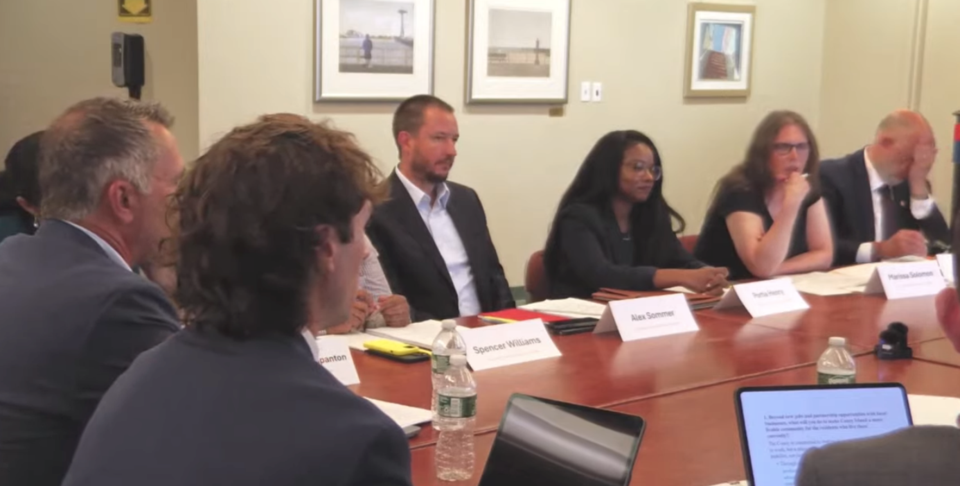
When plans for the proposed Coney Island casino were presented at the first Coney Community Advisory Committee on Wednesday, it came with a stream of hardball questions from committee members.
The smoothest part of the two-hour meeting was when the CAC, which will vote on whether to recommend the state gaming commission award one of three casino licences in the New York City area, voted City Council Member Justin Brannan as its chair. Then came the barrage of questions after representatives of Thor Equities, Saratoga Casino Holdings, the Chickasaw Nation and other associated entities presented their vision for The Coney.
Committee members asked the project representatives about about jobs, transportation issues and funding.
“I was surprised by the chart you put online when it said 8.7% of jobs [created by the casino] were going to go to Coney Island residents,” said committee member Marissa Solomon, who determined that would yield 182 full-time jobs.
According to New York University’s Furman Center, the estimated population of the Coney Island neighborhood is 108,087.
“We’re talking about projections here in terms of how hiring works five years from now,” said Peter McEneaney, a representative of Thor Equities. He added the number is purely based on demographic studies of the area. “That number could be higher, at the end of the day," he said.
McEneaney mentioned that the Metropolitan Transportation Authority was supportive of requests to bring a new express service on the F line, given a potential boost of ridership as a result of the casino’s presence.
“It’s not just for the project, but it would change commute times for residents of Coney Island because now their train service is more reliable,” said McEneaney.
He also added that ferry service to the area was another transportation boost they discussed with the city.
That said, some committee members cautioned project organizers from touting possible subway and ferry enhancements as nothing was set in stone.
There were also questions about vehicular transportation issues, including figuring out how the Belt Parkway would connect better to the area, and how parking problems would be tackled.
Lucy Mujica Diaz, a Coney Island resident who attended the meeting, said she often drives her car in the area and that parking is a major issue.
“This community can’t hold that,” Diaz said about the possibility of hundreds of drivers heading to the casino.
Solomon also questioned the project promise to build a $200 million trust for community for initiatives related to workforce development, boardwalk improvements and more, stating that this figure wouldn’t cover many of the proposed enhancements to the area.
“The trust was never meant to cover all of those things,” said McEneaney. “We can’t solve all of Coney Island’s problems in one trust fund document. The idea was to create a fund to enhance the residents of Coney Island.”
Committee member Alex Sommer asked about long-term emergency management at the casino given the area’s flood risk, especially after it was battered from Hurricane Sandy in 2012.
Sara Davis, a principal of FXCollaborative, said there have been a “number of conversations” on how the casino could be utilized in a weather emergency, where the building itself “will be a place that could be a refuge for the community” and generator service will be available on site.
Prior to the meeting, local officials voiced their displeasure that the initial CAC meeting was held at Kingsborough Community College in Manhattan Beach, which is two neighborhoods east of Coney Island. Officials said the New York State Gaming Commission should have relocated the meeting to guarantee proper community feedback.
The CAC review procedure will continue through Sept. 30, where additional public meetings will be held. The date for the next meeting has not yet been announced.