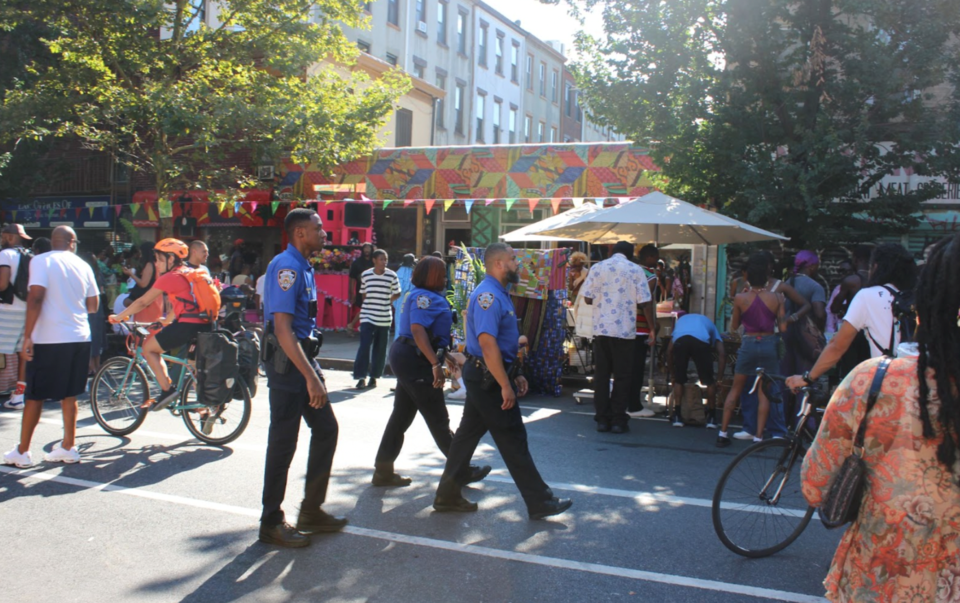
Block parties have long been a New York City staple. For many natives of Brooklyn, the block party is a space where neighbors gather to convene, share a laugh and the latest amongst the neighborhood block association.
Since its earliest inception, the block party vibe has evolved, causing many natives to have varying viewpoints on the authenticity of the culture. Social media creator Bonnie Humpherys took to Instagram to discuss block parties getting away from "the plot," a term implying they're moving away from their original origin and intent.
“I feel like we’re getting to a place where everybody is beginning to think that block parties in Brooklyn are all like Coachella experiences and we’re getting away from the plot,” Humpherys said in her video.

Additionally, some users highlighted the distinctions between the city’s Open Streets program, block parties curated by a block association and those organized by local businesses.
So, what’s the difference?
According to the NYC Mayor’s Office of Citywide Event Coordination and Management, permits for these events are categorized depending on the size of the event, whether or not organizers plan to fundraise, sell food, or if the event includes branded sponsorships or vendors like food trucks.
To be considered a block party, organizers must be a member of a block association, have permission from their neighbors and open the invite to all residents on the block. The event is typically limited to nine consecutive hours on one day and one block, and attendees cannot fundraise or be charged to participate.
On the contrary, a block festival is a nonprofit-sponsored community event that requires vendors to close the block for one day. This type of event allows organizers to sell food and is limited to up to 12 hours.
For Marlon Rice, founder of The Good People NYC, a community outreach organization and curator of Stoop Set, a block party and festival event series, block parties are an act of liberation for Black people in historically Black neighborhoods, like Bed-Stuy.
"This is how we prove our Blackness still exists in the space,” Rice said. “Block parties were an act of community, and even an act of liberation, a fellowship, of connectivity. But now, these block parties are an act of resistance, pushing back against gentrification, pushing back against the whitewashing of our community.”
Stoop Set block parties garner thousands of attendees during the summer months, with events taking place during Franklin Avenue Open Streets and on streets in Bed-Stuy and Crown Heights, having over a $250 thousand financial impact for local businesses and vendors.
Likewise, Assembly Member Brian Cunningham, who represents Prospect Lefferts Gardens, Flatbush and Crown Heights, acknowledges tension between what is old and what is new, but says block parties are becoming more indicative of Brooklyn's changing dynamics.
“This is less about change and more about whether those changes feel inclusive of the people that live there,” Cunningham told BK Reader. “Every block had a culture, and had a specific beat to it, and I think we're just building on that and just adding new layers of complexity with new cultures and new dynamics."
For him, some block parties have changed into long-table-style dinners, while others hold to the traditions they’ve kept for years, with the childlike dynamic still existing because more young families are moving in.
Moving forward, as block parties evolve in size, energy and vibe, the conversation about block party culture isn't necessarily about choosing between old and new traditions, but more so about making sure those native to these neighborhoods are at the center of these conversations and decisions.