
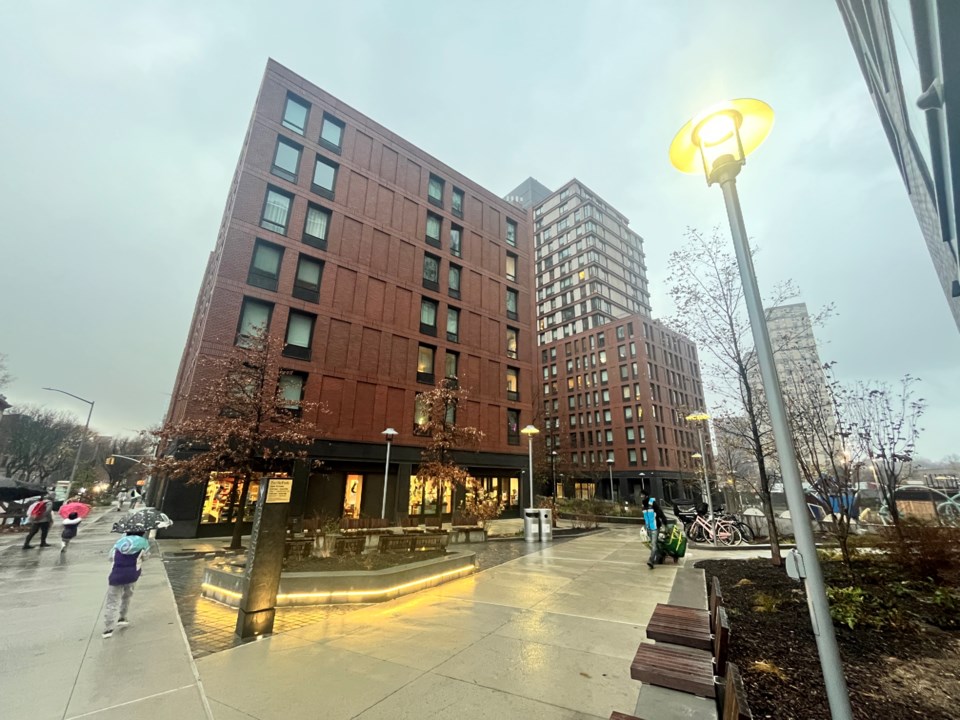
Brooklyn civic leaders and residents eyed the revived Pacific Park project with a mix of relief and skepticism at a recent directors meeting, as a new development team takes over the long-stalled project once known as Atlantic Yards.
On Oct. 6, a joint venture comprising Cirrus Real Estate Partners, LCOR, Fortress Investment Group and U.S. Immigration Fund officially took over the Prospect Heights project from Chinese developer Greenland USA, which fell into financial trouble several years ago, halting construction.
There will now be three meetings organized by Empire State Development, the joint venture and other groups to present a broad plan to the public in the coming weeks, enabling residents to provide their input, according to a Thursday board meeting of the Directors of the Atlantic Yards Community Development Corporation. The state and joint venture are aiming to sign a memorandum of understanding that will outline a board framework on the project by March 31, 2026.
As a first step, the joint venture, called Brooklyn Ascending Land Co., will release $4.5 million into an Affordable Housing Trust, which will support near-term housing construction in community boards 2,3,6 and 8. The trust will eventually total $12 million, according to Joseph McDonnell, managing partner at Cirrus Workforce Housing.
The reboot of the project– that has so far brought forth eight luxury apartment buildings, Barclays Center, a health clinic and a school– was seen as a milestone moment, as the project was officially started in 2003 by the first developer Forest City Ratner. That said, residents noted their deep misgivings as many promises were broken over 20 years.
At the core of residents’ concerns is the lack of affordable housing when there could be another eight or nine buildings that may be built. Despite a 2014 legal agreement that would have forced Greenland, which now owes the state a little over $7 million in liquidated damages, or fines for not building the promised 877 affordable housing units, residents sounded weary that yet another round of negotiations were about to occur.
“We're at a critical moment and I think there's obviously decades of distrust and skepticism that have to be overcome and not just of the developers that are before us but also of ESD, and how ESD has or has not really represented the interests of the public in past agreements,” said Michelle de la Uz, the executive director of the nonprofit Fifth Avenue Committee.
She said the $12 million that the joint venture offered to place in the trust doesn’t compensate for the “extensive” displacement of many African American Prospect Heights residents.
Board member Gib Veconi said he was looking forward to “some realism” as it had been years since a development team had sat at the table. However, he also warned about deep-rooted misgivings about the project.
“People need accountability so if the state doesn’t come through, it’s going to be hard for the public to get behind it,” Veconi said.
Robert Puca, a Prospect Heights resident, urged the new developers to form a long-promised compliance office so residents can register any grievances.
“We don’t need more density, only new affordable housing,” Puca added.
Veconi urged the joint venture to reach out to BSE Global, the current owners of Barclays Center, to include them in the planning process. “Barclays needs to give back as they already got their arena,” he said.
As part of a restructuring agreement, Cirrus agreed to purchase most of Greenland’s debt, which had ballooned to about $300 million, McDonnell said. This reduced Greenland’s debt by about 75%.
The agreement also stopped interest to incur on Greenland's affordable housing fines, according to ESD officials. The fine will be paid by the joint venture should the latest deal collapse and a Modified General Project Plan is not signed by July 2027, said Joel Kolkmann, ESD’s senior vice president of real estate and planning.
McDonnell said the joint venture was looking to build housing units across income spectrums, and in the past, had built many two- and three-bedroom apartments for families.
“This is not supposed to be a bunch of condos on top of railways like some other places in New York City,” McDonnell said, referring to Manhattan’s Hudson Yards. “We are not condo-focused.”
Affordable housing remains a top priority for the state and a "robust" community engagement process will help what comes next, an ESD spokesperson said after the meeting.
"ESD remains committed to working collaboratively with community stakeholders and will provide updates as the process moves forward," the spokesperson said.
Concurrent to the the public meetings, the state and the joint venture will hammer out a draft plan to first cover the open-air railyard owned by the Metropolitan Transportation Authority, as well as determine the outcome of what is known as Site 5, an odd-shaped lot that used to house a Modell’s Sporting Goods store that sat at the intersection Atlantic, Flatbush and Fourth Avenues.
Diane Foster, who was born and raised in Prospect Heights, said not much has changed since she was displaced from her family home on Pacific Street in 2014 due to the project.
“It would have been great to have aged out in my own community,” said Foster, who tried to contain her frustration as best she could as she addressed the board. “I’m upset and pissed that there’s no logic with what’s going on here.”
The first public meeting will take place in mid-November and will cover density, affordable housing and open space topics. The second public meeting in mid-December will tackle streetscape, environmental concerns, economic development and retail/community services. The third and final meeting will take place online in January 2025.


