
Brooklyn residents continued Thursday to press state officials and developers to include as many deeply affordable housing units as possible in the next phase of the Atlantic Yards/Pacific Park project.
During the third and virtual Atlantic Yards public workshop meeting, officials from Brooklyn Ascending Land Co., the new joint venture leading Phase Two of the project, said they are looking to offer affordable housing units to a wide band of Brooklynites making anywhere from 40% to 130% of area median income (AMI).
Joseph McDonnell, a managing director at Cirrus Real Estate Partners, said the number of units they can build will depend on what kind of public housing initiatives will be put in place as part of the final term. The team can build more affordable housing if the cost of the entire project comes down, but the price tag remains high thanks to tariffs and the complex nature of the project that will cover and build over existing rail road tracks.
"In terms of the number of units which can be allocated to that particular income band, 40% to 60%, that will be informed by various public programs and the term sheets associated therewith," he said.
The development team also noted they heard residents' desire for the development team to quickly deliver 1,000-plus affordable units across a wide income spectrum, as well as to add more 2- and 3-bedroom affordable units.
The team presented various scenarios of affordable units that could be part of the plan, which included a 2-bedroom apartment for $1,458 per month for a restaurant worker (with a child) making up to $52,000 on the low end, and as high as $5,476 per month for a 3-bedroom apartment for a family of four making about $211,000 combined.

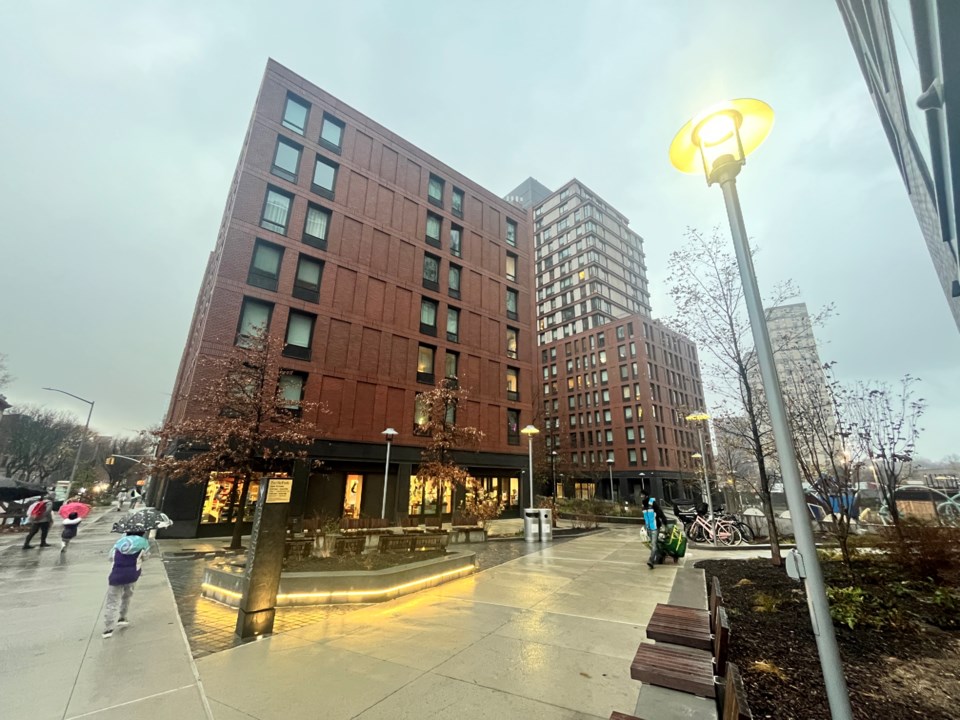
Currently, the approved plan for the entire project calls 16 residential and commercial towers with 6,430 residential units, of which 2,250 units would be affordable rental units. So far eight residential buildings and Barclays Center have been built, which includes about 3,000 apartments, of which about 1,300 are affordable units. The developers have previously said they will likely build a total of about 9,000 units.
Brooklyn resident Raul Rothblatt said he was concerned that the deeper affordable income threshold wasn't low enough.
"I hope your own workers that are part of your coalition here will be able to afford this," he said about union labor that will be working there. "And I would strongly suggest that you lower the affordable numbers way down and also include senior housing and other things."
Community members for years have been sounding the alarm on the missing 877 affordable units, where the former developer Greenland USA was supposed to pay damages for not building the units on time.
To placate the community, Brooklyn Ascending Land Co. agreed to release $4.5 million into an Affordable Housing Trust, which will support near-term housing construction in community boards 2,3,6 and 8. The trust will eventually total $12 million.
Joel Kolkmann, senior vice president of Real Estate and Planning at Empire State Development, said the state decided not to collect the $1.75 million per month damages as it would add too much cost to the project, and possible litigation would stop the project from moving forward.
"The risk of going after that money, and Greenland [claiming] that we didn't necessarily have rights to go after that money, and that back and forth, which would be a legal back and forth, could cause significant delays and potentially years long delays in delivering this project," he said. "That's something we thought that risk is not worth that. And that's why we worked with this development team...to actually secure funds that could go directly into the Affordable Housing Trust fund."
Residents and elected officials also raised concerns about infrastructure and road upgrades, the need for public input on the design of parks and open spaces, and the types of community spaces that could be built during the project’s second phase.
The next virtual public meeting will take place in mid-February, and the first draft of the Community Engagement Report will be released at the end of February.
Construction on the project could start in late 2027 or early in 2028, Kolkmann said.


