
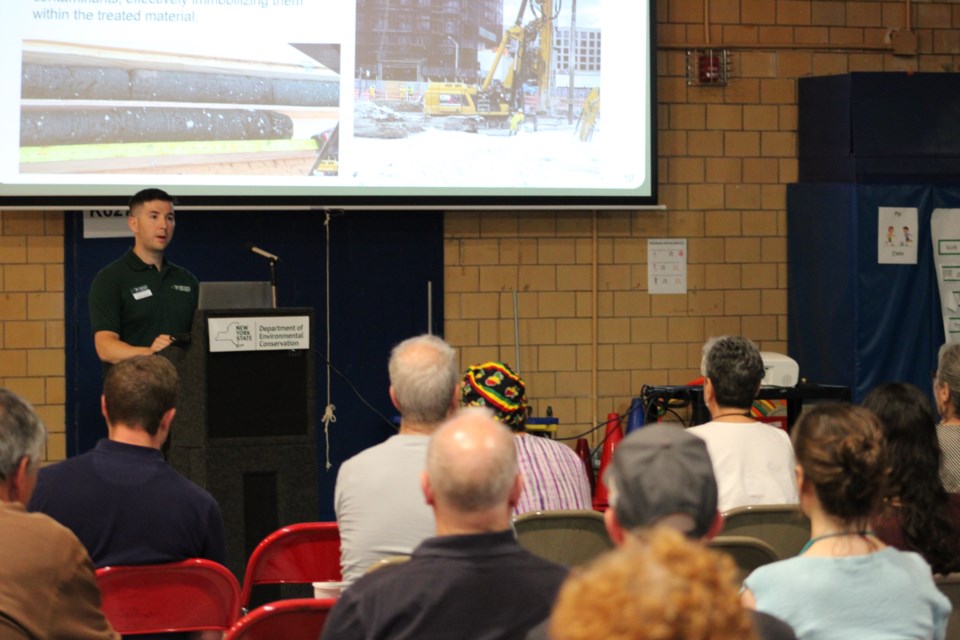
As state officials unveiled their plan to clean up a contaminated site in Gowanus, residents agreed on one thing – the state is currently ill-prepared to properly decontaminate the land.
Representatives from the New York State Department of Environmental Conservation (DEC) and the Department of Health appeared at a public meeting Tuesday to discuss the cleanup of 459 Smith St., a lot that housed a fertilizer and manufactured gas plants. The lot must be remediated before it can be redeveloped to build commercial and residential buildings.
But residents, who have dealt with an influx of thousands of residents to the area after Gowanus was rezoned in 2021, instead aired their frustrations regarding the site’s placement in the state Brownfield Cleanup program.
“This site in particular, and all of these sites, need to be in the state Superfund,” so taxpayers won’t be contributing to the cost of the cleanup, Gowanus resident Brad Vogel said.
According to the state DEC, the Brownfield program encourages private-sector cleanups of contaminated properties so they can be reused and developed.
But unlike the state Superfund program, residents who live in the vicinity of a Brownfield cleanup site have to make certain tax contributions to fund the project.
“Why is this in the Brownfield program that the taxpayers are paying for,” Gowanus resident Joan Salome-Rodriguez said, followed by a round of applause and hollers from the crowd.
While residents expressed concern that the Brownfield program was not sufficient enough to effectively decontaminate the site, state officials maintained that both programs are equally as effective.
“It’s the same criteria,” said Heidi Marie-Dudek, project coordinator of NYC Mega Projects for NYSDEC. “Yes, there’s a difference on who might be paying for it.”
Marie-Dudek added that the Brownfield program is facilitated through a voluntary agreement in which a property owner decides to decontaminate the site, while the Superfund program can be handled by a volunteer party or the state itself.
“I understand your frustration with that. We’ve heard it, and we’ll take it back again,” Marie-Dudek said.
Despite disagreement of how the clean-up of the site should be handled, the state said the site poses a significant threat to public health and the environment based on the potential for “off-site migration of contaminants in the groundwater, surface waters and soil vapor.”
Their plan to address the plot, which is one of five contaminated sites in the area, includes remedial excavation of contaminated soils, treating contaminated groundwater and importing clean material into the site.
In particular, Aaron Fischer, NYSDEC project manager for the Gowanus canal area, pointed to the construction of a wing wall along the site to mitigate off-site migration of contaminants.
But residents were concerned the wing wall wasn’t enough, again asserting that the Brownfield program was not equipped to limit migration between and beyond the multiple contaminated sites in the neighborhood.
“The wing wall definitely needs to be longer,” Vogel said. “It needs to go further inland, based on that very real concern and concerns about future migration off the site.”
In response, Fischer said the NYSDEC is monitoring all land parcels within the area when decontaminating the site to prevent migration.
“We are looking at all parcels and how they interact–hydraulically, geologically…to ensure that the parcels are addressed so they don’t further migrate into previously cleaned up parcels,” Fischer said.
The public comment period for the plan, called “Draft Remedial Action Work Plan,” runs through Aug. 19. The NYSDEC advises that interested parties can learn more about the plan and view project documents online.


